The Crisis
Chief Complaint
What follows is the subjective and objective picture: what practitioners, students, and workforce data are telling us. This is not a prediction. It is a description of what is already happening.
The Pipeline Is Breaking
The Accreditation Commission for Acupuncture and Herbal Medicine (ACAHM) is the sole pathway to licensure in most U.S. states. Since 2016, at least 13 ACAHM-accredited programs have closed. The Oregon College of Oriental Medicine, which enrolled 133 students and awarded 49 degrees as recently as 2023, closed in 2024. In August 2025 alone, East West College of Natural Medicine in Florida closed without warning, Emperor’s College of Traditional Oriental Medicine in California voluntarily withdrew institutional accreditation, and Phoenix Institute of Herbal Medicine & Acupuncture in Arizona remains under Show Cause review. One new program — Lotus Professional College in Richmond, Virginia — received initial accreditation that same cycle, housed within a career school rather than a traditional graduate institution. The net trajectory is unmistakable: the number of programs capable of training new acupuncturists is shrinking faster than new ones can emerge, and the profession has no pathway to licensure that doesn’t run through a single, financially fragile accreditation body.
The Workforce Is Declining
State workforce data from Oregon and Washington illustrates what is happening nationally. Oregon’s acupuncture workforce is declining at -2.09% annually — while physician assistants grew +9.42%, speech-language pathologists +9.40%, and clinical social workers +12.08% over the same period. Acupuncture is the only licensed health profession in Oregon moving in the opposite direction. In Washington, the median age of active practitioners is 52, with nearly half over 55. We do not yet have robust national attrition data, but the trajectory in the Pacific Northwest mirrors what school closure patterns suggest is happening across the country: a profession aging out faster than the pipeline can replace it.
The Debt Is Unsustainable
In August 2023, the HEA Group (founded by Michael Itzkowitz, former Director of the Obama Administration’s College Scorecard) released an analysis of federal programmatic data for 6,300 graduate programs nationally. ACAHM-accredited schools occupied six of the ten worst-performing institutions in the country for debt-to-earnings ratios:
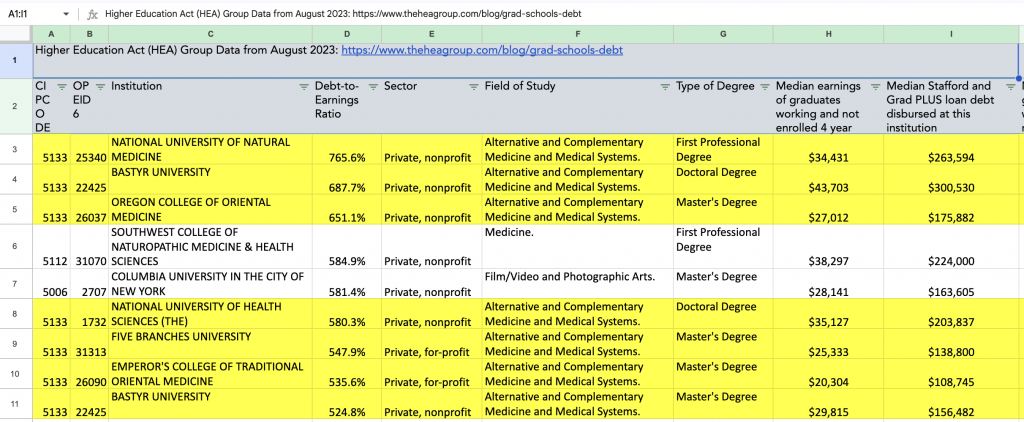
Every program in this table has graduates owing more than five times their annual income. The best-performing program still exceeds 500% debt-to-earnings. Under standard 10-year federal loan repayment, a NUNM graduate’s monthly payment would exceed their entire monthly income — before taxes, rent, or living expenses. A Department of Education slide deck presented in January 2026 projects that 98.1% of Alternative and Complementary Medicine master’s programs will fail the federal earnings test. The conclusion does not soften with better data. It hardens.
Graduates Don’t Earn More Than a Bachelor’s Graduate
The Bureau of Labor Statistics reports a national median wage of $78,220 for acupuncturists, but this figure excludes the self-employed, who constitute the majority of the profession. NUNM’s own 2014 alumni survey found graduates without a concurrent ND degree reported median net income of $24,500 in their first years of practice. Department of Education earnings data shows acupuncture graduates earning at or below what a bachelor’s degree holder earns, while carrying the debt load of a graduate professional program. Critics argue the earnings data undercounts self-employment income. At 765% debt-to-earnings, a NUNM graduate would need approximately $87,000 in unreported income on top of their reported $34,000 median earnings to change the conclusion.
Graduates Are Isolated From the Healthcare System
Most acupuncturists enter practice as solo self-employed providers — not by professional choice, but by structural necessity. Because acupuncture has not been integrated into larger healthcare systems, there are few employer pathways. This isolation makes it harder to advocate for higher insurance reimbursement rates, harder to achieve the patient volume needed for financial sustainability, and harder to build the referral relationships that support long-term practice viability. It also means acupuncture remains on the margins of the broader healthcare system, even as evidence for its effectiveness in pain management, behavioral health, and other conditions continues to grow. The profession trains in isolation and then practices in isolation. This is a closed loop that serves neither practitioners nor patients.
Programs Are Expensive by Design — But It Doesn’t Have to Be This Way
Most ACAHM-accredited programs continue to structure training as full-time, residence-based graduate study: a model that prevents students from working while in school and concentrates all training costs at graduate tuition rates. Biomedical content that could be completed at a community college in the $100 range per credit is instead delivered at graduate institutions that charge $500+ per credit. The current 60-semester credit (2 year) undergraduate prerequisite carries no mandated science coursework, meaning students may arrive without the foundational preparation that would justify either the length or the cost of the degree they’re entering. This is not universal. At least two acupuncture schools have demonstrated that modular learning structures can allow students to work while training and pay as they go, without federal loans.
Credit Transferability
Students who attend ACAHM-accredited programs typically find their credits non-transferable to state and regional universities. Most programs lack articulation agreements with regionally accredited institutions and students who need to change programs, or who wish to pursue additional healthcare training, often must start over. When OCOM closed in Oregon in 2024, students’ credits had no value outside the ACAHM system.